Baseplan cleanup
SIFDR cleans up the CAD baseplan on architect DWGs for MEP firms, so the engineer can begin work rather than prepare the drawing first.

Strip the Noise.
SIFDR — Smart Intelligent Fast Drawing Recognition — is the first DraftCore product. It cleans up the CAD baseplan on architect DWGs for MEP firms, so the engineer can begin work.
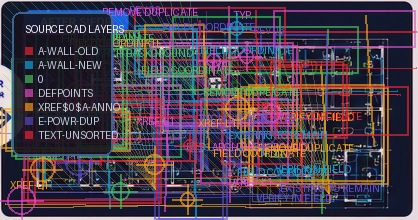
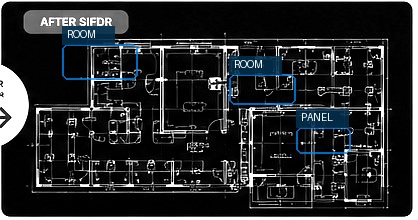
Move the divider to compare the original source file with the cleaned, structured output. The sequence is an illustration, not a live processing session.
Eight cards, and each one is a capability the product actually has. Nothing here describes something we intend to build.
SIFDR cleans up the CAD baseplan on architect DWGs for MEP firms, so the engineer can begin work rather than prepare the drawing first.
Inconsistent source layers are cleaned up into something an engineering team can work from.
Repeated and overlapping geometry is reduced, which is most of what makes a source file slow to work in.
Conditions in the source file worth looking at before design begins are surfaced rather than buried.
SIFDR creates the reflected ceiling plan grid. It does not populate it — see the boundary below.
SIFDR also cleans up reflected ceiling plans you already have.
Run the drawings through SIFDR and the reference points come back aligned — they XREF together. The alignment is in what comes back; SIFDR does not change the architect’s drawing.
SIFDR detects fire walls from the plan it is given and flags fire-rated hatches rather than deleting them. Your engineer reviews the result and can change anything SIFDR misses or gets wrong. It does not tell you the rating — that stays with your engineer and the architect.
Populating the RCP stays your engineer’s work, and we would rather you knew that before you started than after. SIFDR is a tool that assists your engineer’s work. It is not the final word, and it is not a compliance engine. Your engineer reviews the plans for accuracy, and the stamp is theirs.
A firm that discovers these conditions after sending the wrong file concludes the product is broken. We would rather you knew first.
SIFDR reads both and writes both. It has its own CAD engine, so it fits the workflow you already have rather than replacing it.
A PDF works as an input only if it was exported from CAD and still carries its layer information. Scanned, photographed, or flattened PDFs will not work, and SIFDR does not return PDFs.
One floor, one unit type. Multi-unit buildings are handled one unit at a time — so a 40-sheet set is not one upload.
The architect moves a wall. On a revision you re-run SIFDR instead of cleaning the same drawing again — for the life of the project.
SIFDR reduces the setup burden while your engineer keeps visibility and control over every change. It works today — it is in testing, and it is not polished, but it is not a promise either.
Help us understand your source-file problems and what you need back. The first month is free.